Monday, March 19, 2012

Beginning of year 3

March 17, 2010
March 17, 2012
The picture on the left is from of the earliest tangible evidence of a garden for the Church Hill Community.  On St Patrick's day, 2010, The City plowed our garden plot.  As you can see, the weather was frosty there were only faint hints of Spring.  

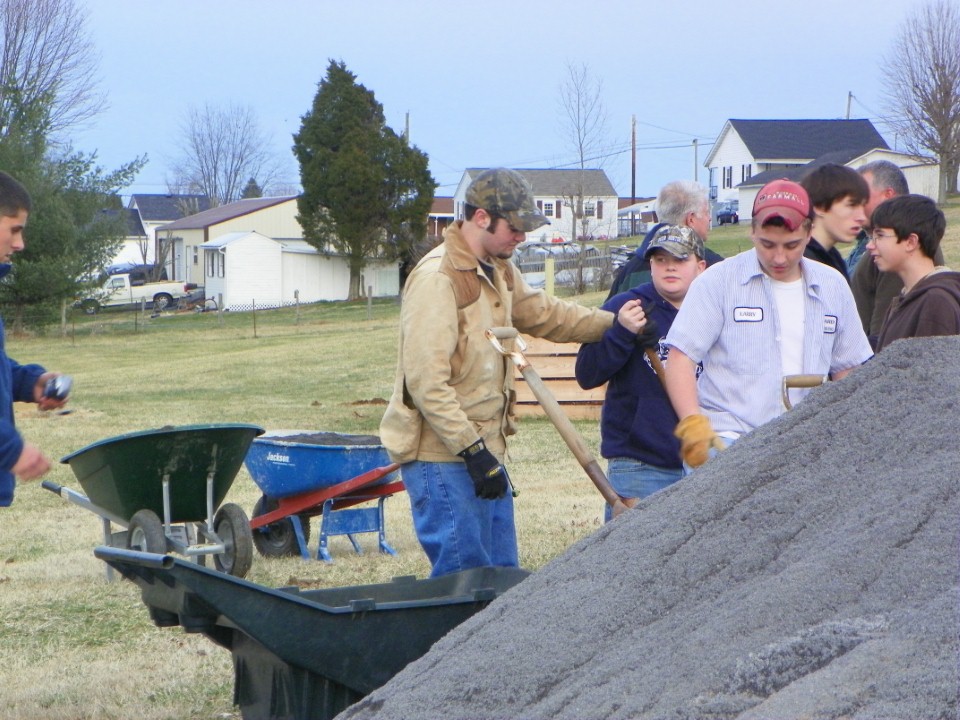
The picture below is after our March 17, 2012 work day.  We were assisted by 5 Master Gardeners and a full complement of helpers from First Baptist Church in Church Hill.  There was a huge amount of work achieved by the group.  The 20 yards of manufactured stone was wheeled between the new beds constructed last fall.  To prepare them for the growing season, 10 cubic yards of topsoil was used to help fill the new beds.  We had prepared the beds by covering the bottoms with cardboard to retard weed growth and adding leaves.  The beds will be carefully monitored over the next couple of weeks to see the amount and type of weed seeds that germinate from the new soil.  There did not appear to be large amounts of Bermuda grass rhizomes in the soil.  I checked this evening, but no germination was apparent.  The only new additions were some small deer hoofprints throughout the plot.  Evidently they must be observing our progress.  
This is most of our work crew from the day.  The youth group is planning to adopt 3 or 4 beds as a group project for the coming gardening season.  Another group work session is planned for April 7 when we will be joined by Boy Scouts and members of this youth group. 

We did harvest 15 pounds of cabbages and various greens last Wednesday.  This has been the year without a winter.  The weekly work session this week will be devoted to adding compost to beds, and planting.  The season seems so advanced, but the first official day of Spring is not until Wednesday.  Hopefully winter will not come to visit after the arrival of Spring.

Wednesday, March 30, 2011

Linking Gardens and Food Banks Terrific Idea

Ample Harvest is the kind of site that makes you say, what a great idea, why didn't anyone think of that before.  Follow the link to find out more about their worthwhile programs. 


We had several work days in March.  There is bed preparation and cleanup, then the first planting.  Onions, peas, lettuce, radish.  March has been very good for rain.  At the end of the month, we are over 3" above our normal rainfall.  The items planted have started to pop through, even though the nights have been cool and sometimes frosty. 

We did plant quite a number of cabbage family transplants. Broccoli, cauliflower and two kinds of cabbage.  To assist in the organic controls, we built a barrier or tent to exclude the cabbage moths.  On warm days, more than a few are already in evidence. 

The material for the "tent" is non-woven fabric.  It is available commercially, but expensive.  Our solution was to reclaim and reuse the fabric from thrift store bed skirts.  The outside ruffle was removed and sent to the quilting seniors.  We clipped the fabric pieces together using a piece of electrical conduit and bamboo stakes for support.  It was secured with old clothes pins.  Our construction was immediately tested with 30+ MPH winds and heavy rain the same day.  It is standing fast and firm two weeks later.  Also shown are the towers constructed for early peas .  We planted both regular and edible podded varieties.  UP NOT OUT. 

This photo shows several of the new raised beds that were constructed by the Scouts.  With the new beds, we have nearly doubled the amount of growing space available from last year.  About 80% of the original plan has now been constructed.  In addition, the third compost bin was built on another March work day.  This brings the number of bins to three.  We now have the flexability to move the compost around between bins for faster decomposition and have additional storage space for composting. 

The weekend edition of the Rogersville Review carried an extensive story about the garden.  Several of our regular volunteers were pictured.  The text featured an appeal for donations to help improve and expand the garden. 

We were contacted by the Church Hill Elementary School.  A group of students from the Kindergarten and first grade classes will be learning about gardening, planting and weeding over the next several weeks.  They will have a dedicated bed to plant and harvest.  Before coming to the garden, the girls are planting sunflower seeds in school and will transplant them in the garden.  We plan to tag each plant with the students name so they can watch the growth  of their seedling over the summer and into the fall. 

The weather continues to be unsettled.  We have had frequent, heavy rains, sometimes with a sprinkling of snow.  This has been mixed in between 70 degree sunny days.  The daffodils are past their peak and redbud trees are in full flower now. 

March Winds

The Eagle (Richard Peters)  Has Landed

The Church Hill Boy Scouts adopted the garden for an Eagle Scout project.  The eagle is Richard Peters.  He planned, directed and controlled the installation of  7 large and 4 small raised beds, completion of the second compost bin and the installation of the manufactured sand in the garden path, erecting 3 bluebird houses and construction of the garden information center.   The work days covered several nights.  


With a donation from the Community Clothes Closet, 20.75 tons or manufactured sand were purchased from Vulcan Materials - Kingsport quarry.  The company extended a substantial discount, making the donated funds stretch further.  In addition, the City of Church Hill picked up and transported the sand to the garden site.  The pile looks pretty daunting,  but the 42,000 pounds of sand was quickly moved between the rows to act as a permanent weed barrier.  

Scout leaders, other Eagle Scouts, scouts and parents all helped in moving the sand and the other construction chores.

 The crew worked past sunset and finished most of the pile under the glow of the street lights, adjourning about 8:00.  

 Scout leader Kipp West is shown with Brian Kramer and the new  Information Center for the Garden.  We used the rear of the existing sign to mount the center.  A good recycling project, the glass door was a refused custom order at a local lumber yard.  The closeout price of $1.00 needed some additional modification, but made an ideal waterproof access to the center.  We now have a central location for all our messages and information about the garden.  We are now creating the graphics and materials for our volunteers.

The scouts also constructed the second compost bin.  They removed all of the cardboard weed barrier from last year and placed in the bin for compost material.  

With the assistance of the Scouts, we were able to complete all of our construction goals for the year before the growing season really got started.  It was a great project.  The young, strong backs much appreciated. Truly an example of the wonderful community support that the garden is generating. 

Saturday, February 19, 2011

First Harvest of 2011

 The "off-season" is officially over and the gardening season has begun for 2011.  We had our first work day on Feb 17th.  It was a great day as you can see.  After our morning breakfast session with the Seniors, it was off to do some garden maintenance.  The mini-composters we had established in the tomato cages were emptied and the contents moved throughout the garden beds.  The composting was not really complete, but we wanted to spread it all so it would mulch the open beds, and get rained on in the next week or two.  The contents of the 10 cages filled nearly every bed.  

The best news of the session was welcoming several new volunteers to our crew.  Marcia enlisted a Rogersville gardener to join us for the breakfast and the work session and Judy Penley brought another master gardener, Connie to join us for coffee.  Christine B joined us for the garden work a bit later.  With the weather in the 50's it was time to get growing. 

There are a few signs of growth in the garden and in our area.  The spinach we planted last Fall looks very happy in 2001.  Judy and Christine picked some leaves for a salad.  This year's first harvest was THREE months earlier than last year. 
The garden has been adopted as a project for a Church Hill Boy Scout as he works to attain his Eagle Scout badge.  I met with the Scoutmasters and Scout last week and we have a second meeting to finalize the project on Monday.  More on this next blog.

We have also received a Blue Bird house for the garden.  Carl will receive our first new Thank You card collage.  He has also volunteered to make a bench for the garden. 

The epic tome about establishing the garden, From Dirt to Dinner, The Art and Science of Producing a Garden, has been finalized, uploaded and is now for sale at www. Blurb.com.  Marcia has purchased some initial copies for review and presentation to the library and some of our major donors.  The Church Hill Library has also scheduled a Firends of the Library meeting that will discuss the process of writing, editing and publishing a book.  Brian will do the presentation on May 12th.  

It has been less than a year since this whole process began.  While we have had some frustrations, we have also had some very remarkable achievements.  With so much of the infrastructure in place, we can build on our seccesses and focus on our 2011 goals and growing. 

Saturday, February 5, 2011

From Dirt to Dinner

The blurb book, From Dirt to Dinner, The Art and Science of Producing a Garden,  is in the very final revision stage.  Since the last post, all the text and pictures have been funneled into the Blurb software.  The formatting that was lost has been restored.  Marcia has been diligently correcting my exuberant use of bold and underline and we are now finalizing the remaining 50 or so pages.  With the Appendix, the book totals 114 pages.  The format is a pocket book size with a color cover.  All inside pages are  black and white.  The illustrations we chose were from the CHSC garden, victory garden posters from WWI and WWII, and  Fred, a handsome garden toad.  It was a very engrossing project that might even prove useful to others.  As insane as it sounds, we have been collecting quotes for Vol 2.


We have been working on our 2011 goals and have contacted the local school principals about including the garden in the school lesson plans.  The intermediate school has forwarded our letter to the science teachers.  Perhaps a bit more followup will be needed with the elementary principals. 


 There is an interesting development in gardening called High Tunnel beds.  We are considering requesting a grant from the USDA to erect a demonstration tunnel for farmers in our local counties.  Since we are an organic garden we seem to be on a very fast track for approval of 90% of the construction costs. As often is the case, our reservations are about the amount of available help for a project like this.  We would need lots of bodies not only for construction, but ongoing gardening work to plant, maintain and harvest.  There would also need to be quite meticulous records about tunnel temperatures and humidity levels.  The tunnel would also have to be opened and ventilated nearly warm day.  The tunnel extend the seasons considerably and provide farm income from late/early salad crops, berries, or flowers.  It would be a very exciting adventure, but may be too much project for the amount of labor we can attract.  The application needs to be completed in early March and there is much to be considered and completed if we are going to try to qualify for the money this year.  

Our first garden work day is scheduled for Feb 17th.  We are going to do a bit more cleanup and then spread the compost from the mini-composting stations (tomato cages) and tackle the big bin as well.  By spreading early, any material that is not fully composted can be exposed to the weather and finish in place.  Our winter has been unusually cold and snowy (for Tennessee).  It will be interesting to see how the piles have "worked" over the last few months.  

We have also been talking with our local scoutmasters and have a scout that would like to assist the garden as his Eagle Scout project.   We are still finalizing the details, but hope that a garden bench and flower bed surrounding the sign might be part of this project. 

Finally, the Fiskars Orange Thumb grants will be announced February 11.  All we know now is that our submission was accepted and received before the deadline . 


Sunday, January 2, 2011

2011 Gardening Season Begins

2011 began with our family growing.  Our second granddaughter, Ashlyn Mary was born January 1st.  As we are sorting our our plans to go and visit, we are starting our garden activities.

We have completed our grant proposal for Fiskars.  There was a lot of hard work devoted to the proposal, but we did manage to resolve two nagging issues during the process.
  1. We received a positive response from First Utility and will have water at the site this year.  They will re-establish the connection when the ground warms up.  One of our projects early on will be to make sure we can securely lock the connection and obtain hose, nozzles, soaker hose for the watering chores.  We will be looking for donations from the Seniors and put the Clothes Closet on alert for items that may come to them.  
  2. The Second issue was a solution to the land use question.  After talking to Mayor Deal and the City Recorder, the garden was described as a Civic Asset located on property owned by the City of Church Hill.  As such, the length of tenancy, like the City Charter, is perpetual.  
For the Grant and also our continuing relationship with the Master Gardeners, these were important steps.  Organizations want to make sure that a project has a reasonable prospect for success and longevity before funding takes place.  If we are selected by Fiskars, the garden will receive $3500.00 in cash and $1500.00 of Fiskars tools.  The announcement date is February 11.

At our December evaluation session, in addition to adopting our 2011 goals and objectives, we listed a series of projects that we wanted to consider.  The list went out to our Garden Directors and others for their comments.  This week we will prioritize the list and complete things as funds become available. 
Project Description
Information Center  Posting info at the garden.  Make with recycled materials. Old window on box frame.  Attach to existing sign and make roof to keep rain out of the box.  
Manufactured Sand for Rows Needed for weed control in between the rows.  About 4” depth would be enough for adequate control
Additional Compost Bin We have good manure supply and want to expand the amount of compost available for the garden and eventual Community Garden
Additional Raised Beds For eventual community garden and expanded production at existing site.  We would expand flowers grown and herb beds. Fit some for season extension with row covers.
Soaker hose, Hose for watering  Water connection has been approved by 1st Utilities.  Will make transplanting and watering in dry times easier
Produce scale Needed to record production on a consistent basis.  A dietary scale is fine if it can handle 20+ pounds.  Don’t need Legal for Trade and calibration
One or Two Bluebird Houses Way to encourage birdlife at the garden and provide insect control.
Bat House  Way to provide shelter for bats and to provide insect control

 We have cost estimates for each of the projects.  After the meeting the prioritized list will be posted.

Also at the meeting we are beginning our outreach to the area schools.  The educational component of our objectives needs to be addressed soon so teachers can incorporate the garden into their lesson plans and we can think about times and projects that are age appropriate.  There is some presentation material available, and we want to develop a list of teachers and administrators to contact. 

The Blurb book has also had nearly daily attention.  While the grant proposal took front stage for the last 10 days of last year, there are over 15000 words written for the book.  We are using Google Docs to collaborate on the writing and editing--the program is not very user friendly at this time.  Selecting artwork and photos is much more difficult and time consuming than word processing software.  We can all see the various versions and make suggestions and changes in real time.   Once we have settled on the text, it will be exported to MS Word and the final tuning and image placement can take place.   Our goal is to publish before the end of April.  At this point, we seem to be ahead of schedule.

Our December weather was some of the coldest on record in the Tri-Cities.  The end of the year has given way to better weather and temperatures in the 50s.  The snow has disappeared and the effects of the weather on the remaining garden plants will be assessed early in the week.  The kale pictured above is usually tough enough to easily brush it off and continue growing.  It will also be a good time to see how the compost piles are progressing.  The bacteria and fungus are like people, they slow down in cold weather.  There was some rain at at least two different times in December.  Warming weather should stimulate the pile to heat up considerably.  We should be able to soon put down the seed catalogs, stop dreaming and get growing.
.

Saturday, December 18, 2010

A Progress Report

 This is a fairly uncommon, though by no means rare photo of snow in Church Hill.  This photos were followed by a real treat, a combination rain, freezing rain and ice storm.  Under it all there are still signs of life in the beds.

This is also a rare photograph it shows the slow march of 10 compost bins, FKA tomato cages, to Spring Planting. The composting action was evident in the warmth of the outside boards on the big bin.

The year-end garden evaluation was held December 9th.  After we worked and ate, the conversation was distilled and recorded.  After it was submitted to the Garden Directors and some suggestions incorporated, this is the lump of work that we would like to do in 2011.


Church Hill Senior Center Garden
2011
Goals & Objectives
Goals
  1. Increase senior/public participation in planting, harvesting and maintenance of the Garden
  2. Find a long term solution to water availability at garden site
  3. Develop and prioritize list of projects requiring funding
  4. Continue to expand raised bed and compost bin infrastructure
  5. Implement effective partnership between garden facilities and Church Hill students
  6. Obtain a long term agreement on continued use of garden site
  7. Develop short/long term solutions to path weed control
  8. Increase production by 10% in 2011 by more effective use of space, earlier planting, additional beds, greater soil fertility, and increased composting.
  9. Implement liability waiver policy and establish garden rules for all participants
  10. Publish Blurb book by 4/30/2011 about 2010 garden


Objectives
  • Meet with Seniors to discuss garden and need for additional member participation
  • Continue to publicize the garden through blog, television and press coverage
  • Talk with Elementary School leaders and teachers about including garden in curricula
  • Build message center for participants at the garden site
  • Include garden activities in Senior Center monthly newsletter
  • Contact FFA leaders to ask for participation by raising plants and assisting with bed construction labor
  • Talk with Boy/Girl/Eagle Scouts about participation
  • Continue conversation with 1st Utilities about water at site. If necessary, seek alternative water storage alternatives
  • Talk with Carter Valley Elementary leaders/teachers about garden by late January 2011and present logical plan for their participation.  Ask for their assistance in planting, Sunflower project and offer to supplement their lesson plans about seeds, gardening, photosynthesis etc.
  • Schedule and conduct at least one public session about raised bed gardening, sustainable or organic practices, and or composting in conjugation with Master Gardeners.
  • Form list of prioritized projects requiring funding, develop costs to implement and raise money to complete at least 2 projects designated as “significant”
  • Finalize and submit Fiskars grant proposal
  • select and implement Waiver of Liability forms and procedures and develop Garden Rules
  • Provide for uniform collection of volunteer hours, weighing produce and reporting of production
  • Develop recognition system for Donors
  • Continue with organic policies
Well there you have it.  Perhaps too broad, and perhaps too  optimistic.  


We have received a positive reply from 1st Utility.  They will rehabilitate an old connection in the garden parking lot and have water available in the Spring.  They have capped the rates and given us a rate similar to the area churches.  This is a significant step forward for the garden and also in our effort to obtain a grant for the garden.


The work on the Blurb Book has shifted into high gear.  The show and ice storms provided a convenient excuse to stay inside and write.  We are using Google Docs to co-author the tome.  At this point we have over 11000 words, and a reasonably bad opinion of Google Docs.  There is going to be some considerable dancing before the thing is ready to hit the presses, but the text is coming along quite well and starting to sound somewhat coherent. The book has helped me focus on some of the issues that need to be completed and changed for next year.  

Work to finish the Fiskar's grant proposal will restart next week.  We are waiting for an answer from Mayor Deal regarding a long term usage arrangement for the garden.  The "last Call" email was received last week and the submissions must be received by year end.  We are not spending the money until received, but the $1500 worth of Fiskar's tools would be wonderful.  

Thanks to all who helped during 2010.  Merry Christmas and Good Growing in 2011.

Thursday, December 2, 2010

Season Statistics

This is the point where we compute the statistics and start evaluating the 2010 garden.  There is some Kale and Turnip greens that will survive the typical Tri-Cities winter. So there will be some additional items to add to the production for this year.  But for all real purposes This Is IT!

 Crop                   Pounds or Units                        

Beans 20.25
cantaloupe 7.00
corn 112.00
corn stalks 47.00
cucumbers 113.00
cushaw 229.50
eggplant 1.00
feed corn 21.50
floral arrangements 34.00
kale 1.00
lettuce 1.00
mustard greens 26.50
okra 17.50
peppers 22.50
plum granny 7.50
puff ball 2.00
radish 19.00
spaghetti squash 39.25
sunflower heads 103.00
tomatoes 162.50
turnip greens 6.75
watermelon 21.50
winter squash 11.00
yellow squash 61.75
zucchini 53.00

1141.00


In addition we have about 250 cubic feet of compost in process.  This is comprised of 14 truck loads of  shredded leaves and horse manure.  The big central compost bin holds 120 cubic feet and the 10 wire tomato cages have a total of 105 cubic feet of material.  There was one bed that was empty, so it was filled with the same material.  This would be another 25 cubic feet of material. 

In the Spring, there should be enough compost to fill all the existing beds to the top.  We limped along with the basic soil fertility( as found) and only had about 50 cubic feet of compost for soil amendment. With enough strong backs next year, we can do an instant replay and fill the big bin again for some compost to use in the fall and to fill any additional beds that are constructed.  We still have a good supply of leaves that will be available and there should be large amounts of horse manure available by Spring.

The Garden Evaluation meeting will be held December 9th.  Many of those invited have responded positively.  We are hoping for a good turnout and a productive session.  A letter has been prepared asking First Utility District to donate a water connection and water to use for the 2011 season.  We shall see.

Tuesday, November 23, 2010

Last work session

 Brian and Judy are loading one of the Truckloads of horse manure at the secret compost location .  A week earlier, we had loaded leaves and manure.  During the week, additional leaves and manure were transported and placed in the compost stockade. 

 Brian, Judy and Marcia enthused and effused loading the first of an additional two loads of manure. 


Only crazy committed gardeners can get excited about shoveling a truck or two of manure and be all smiley in the photos.

The bin is finally full.  There are a total of 9 truckloads of material in the bin.  We had some small amount of material from the garden.  However, the tomato vines corn stalks were taken to the landfill to prevent the spread of powdery mildew, and  southern corn rust.

The compost bin measures 6 feet x 4 feet and is 5 feet high.  Doing the math, it contains 120 cubic feet.  Since the manure was already "hot" we expect the pile to heat quickly.  It has been rained on several times during the loading process.  So we have all the ingredients needed for a treasure trove of Black Gold in the spring.  The leaves are not very compact and the pile will settle to about half the current height.  We are also using the wire tomato cages as mini-composters.  About 1/3rd of the height has been filled with manure.  Additional leaves and manure will fill the height.  We will see how much composting will take place since there is not much volume in the cylinder.  The material can either remain in the cage or be scattered in the bed. 

There are post holes already drilled and enough treated lumber has been purchased to construct a bin like the one already filled.  If the weather cooperates, we may have an additional bin before Spring.

Monday, November 15, 2010

composing and composting

On November 11th, the composting bin received its first large deposit. Two truckloads of partially shredded leaves and horse manure were picked up and placed in the bin by the "usual suspects".  Only gardeners can really get excited about locating a prime deposit of horse apples.  One of the Senior Center members provided the hot tip and we were off.  The manure was at a farm quite close to the garden and was steaming when we loaded the truck.  It was very clean and did not contain the detritus that sometimes accompanies the barn run stuff. Because of the garden's location we needed to be careful of the appearance and odor of compostable materials. 

It is preferable to know the types of trees when you are composting leaves.  Certain trees and their leaves (such as black walnut) contain toxins and can inhibit growth of certain garden plants. The leaves we used were mainly maple, tulip poplar, gum, and pecan.  If grass clippings are included in compost, it is preferable to use clippings from lawns that have not been treated by lawn services. 

Another composting session is scheduled for Nov 18th.  The weather hopefully will cooperate in placing another truckload of leaves and manure.  This will probably be the last gardening session of the year.  We plan to harvest the remaining mustard, radishes, and other greens.  The volunteers are all scattering for the Thanksgiving holidays and we want to gather and distribute as much as possible before a killing frost. 

Sunday, November 7, 2010

Billions Perish as Frost Decimates Populations in Church Hill--Species from Arachnids to Zinnias Succumb to Sub Zero Celsius Temperatures

As we changed the time last night, nature also changed the seasons.  At 6:00 AM when the dogs shook the family out of bed, the temperature was 23 F .  I took a few pictures showing the demise of a few old garden friends.

The tough garden geezers brushed it off and are back to growing for another day.

Saturday, November 6, 2010

hardfrost and harvest

The weatherman promises that there will be a hard frost tonight with temperatures dropping to the low to mid 20's.  After consulting Marcia, I harvested the Black Seeded Simpson lettuce,  There was one pound after cleaning.  Picked a large bunch of radishes the day before and pretty much cleared out all that were ready to pick.  I wasn't really thinking about harvesting the local wildlife, but came on this large group of wild turkeys on the way to the garden.  Cut the heads off the lettuce, but the turkeys are still roaming, blissfully unaware of a certain holiday later this month.

People ask me every day, "Garden must be done by now??" and are amazed that we are still picking things every week.  We have picked 31.25 pounds since the last posting in October.  The lettuce would not have survived the overnight temperatures, but the mustard, kale and turnip greens will all be fine and continue to produce.


The last of the floral arrangements were distributed on Oct 29th.  There was not many remaining flowers, but some holly, nandina berries, cosmos and herbs from other gardens combined with  snapdragons, okra foliage and some other flowers to make 5 bouquets.  The staff at the health department send a very nice "Thank You" card for the arrangements they received.

The Rogersville Review  printed a very nice article about the garden in their October 20th edition.  It was on page 16, however this is the first page of their Life & Style Section.  It was a full page long with several photographs.  Our thanks go out to Joel Spears,  feature editor, and the Review.

We have located a supply of horse manure and intended to pick a truckload up this week.  The heavy rainfall that morning canceled the loading, but we intend to get a big batch of compost started before the end of this season. The delay will also enable us to incorporate a truckload of partially mulched leaves to the pile.  The wind, rain, sleet and hail of today and the past week have almost ended the leaf peeping season.  The cyclone rake gizmo was ready to pick up, but it was too wet for the operation today. 

The initial work on the Blurb book has started.  We are gathering information from the web and have a draft outline that is being reviewed.  A meeting to evaluate this year's garden and plan for next season is scheduled for later this month.  There is only a little clean-up work left to complete, so this is a good time to start the review and think about improvements for next season.

Tuesday, October 19, 2010

Fall gardening

 EXTENDING THE YIELD AND THE SEASON

 Our Fall plantings are now ready to be picked.  This is the curly mustard.  It was one of the first Fall greens we planted as we removed the peppers and tomatoes.  Many gardeners are weary of the grind of weeding/planting/preserving by the fall and head for the tiller to put the garden to rest for the remainder of the season.

Doing this makes many miss one of the most rewarding gardening season.  The hot sun is gone and shorter days slow the growth of the weeds.  The cooler weather is the perfect time to plant the greens that would run to seed quickly in the hot summer sun.


We have harvested 5 pounds of radishes this late season.  Another added benefit, the cool weather usually banishes the worms.  We have not had any worm damage to radishes harvested this Fall.  The cool weather and more moisture gives the radishes tender tops.  Yes they can be eaten!!  In late Spring, the tops are often rough, hairy and tough.  Later in the year they are tender and delicious.  Try some in your salad, or add to pot of greens.  There were French Breakfast, long White, and the Sparkler red radishes shown here. We have one other patch planted and starting to mature if the weather cooperates.


 We planted a 12' x 4' bed of turnips and kale.  The kale is a cole family member and is tough enough to survive and grow during a moderate winter.  I have harvested kale from snowbanks in a Wisconsin Winter.  It was frozen solid, but worked remarkably well in winter soups and stews.  There is something very satisfying about harvesting something long after your neighbors are totally dependent on items trucked in from half a world away.

If the kale survives, it is tough enough to start growing in earliest Spring to provide you fresh greens in the New Year.

 This Black Seeded Simpson Lettuce is also happy in the Fall garden.  Both lettuce and Spinach enjoy the cooler weather and hold much longer in the cooler weather.  A light frost will not harm the lettuce or spinach, but they will not survive a heavy frost later in the season.

Both leafy greens are much more tender in the fall and will be a real treat in salads,  I like to add mustard greens to my salad for a peppy flavor.  Add some cooked beets and mandarin oranges to make a colorful and unusual salad combination.

We did plant beets in one of the raised beds.  They are progressing fine.  Even if the beet roots do not develop enough for a big mess, The beet tops are at least as tasty with a splash of vinegar and butter.

Our harvest total for the year is nearly 1100 pounds.  With a couple more pickings of mustard, turnip and kale, we will top that target by the end of next week.

We expect to see Local news coverage of the Senior Center Garden in the next week or two.  We have articles scheduled for publication in "Hawkins Today" and the "Rogersville Review".  Marcia, one of our Master Gardeners, created two collages of pictures for the garden.  We presented one to the Church Hill Senior Center and the Community Clothes Closet.  Robert Simmons, one of our dedicated photographers also got a copy this morning.  They were a beautiful reminder of the successful season and a small thank you for all their hard work and support during the season.  We have indeed gone from dirt to dinner.


Sunday, September 26, 2010

Half Ton Plus!!


Beyond all of our expectations.  We have harvested over 1000 pounds of items from the garden.  The growing season is not finished.  There are greens planted and growing, tomatoes, okra, and peppers continue to ripen.  There are also some additional floral arrangements that can be produced.  So we ain't done yet.

The corn stalks have been partially cut and used to decorate the sign at the garden.  The remaining fodder will go to the Church Hill Library to help decorate the front of the building for Fall.  There are some Cushaw Squash that will be used for decorations as well.  

But let's look at what we have done.

                                                       POUNDS
     Beans                                              20.25
     Cantaloupe                                        7.00
     Corn                                              112.00
     Corn Stalks for decoration                   47.00
     Cucumbers                                      113.00
     Cushaw Squash                                229.50
     Feed Corn                                         21.50
     Flower Arrangements                          15.00
     Puffball  Fungus                                   2.00
     Okra                                                16.00
     Peppers                                             9.50
     Plum Granny's                                     7.50
     Spaghetti Squash                              39.50
     Sunflower Heads                              103.00
     Tomatoes                                       123.25
     Watermelon                                      21.50
     Winter Squash                                  11.00
     Yellow Squash                                  61.75
     Zucchini                                          53.00

TOTAL                                                   1013.25#

Looking back at the posts, There was a brief, insane moment when we thought we might get to 500 pounds of produce. We did get a late start.  The beds had to be constructed and prepared before anything could be planted.  We did suffer from very dry conditions throughout the growing season.  We needed, and continue to need additional support from the Seniors.  But this is an absolutely Fantastic Result!!

There should be some mustard to harvest this week.  The weather has turned colder and we are to have rain today and tomorrow.  This should encourage growth of the Fall Garden. Tomatoes, Okra, and Peppers will continue to be productive until the frost.  Conceivably we may harvest an additional 50 pounds before the season is over.  The Senior and Community Clothes Closet have each received roughly half of the items produced.  We are proud and pleased to have attained these results on behalf of our chosen recipients.

Friday, September 17, 2010

Harvesting and Fall Gardening

Since the last post, we have been busy harvesting and also planting Fall crops.  Most of the original plantings have completed their growth cycle and been harvested and cleaned up.  There are still some tomatoes, okra and flowers that are contributing to our harvest totals.  The amount harvested to date is 988.75 pounds.  The total is, frankly, far beyond my most optimistic wild dreams.  This is the "before" picture.  We have harvested the sunflowers and the remaining corn.  Beans have been taken out as have the cushaw and spaghetti squash.  There a couple of pumpkins that are developing, but perhaps not fast enough to beat the frost.   

Total weight of the sunflower heads picked was 103 pounds.  Some of the heads went to our intrepid work crew,  some to the Community Clothes Closet for sale and the remaining went to the Senior Center.  The sunflowers were one of the must do crops for the garden.  They were an attention getter, and have a high perceived value.  Next year, in addition to the mammoth variety, we hope to plant some of the more decorative varieties. 


As most of the vegetables have been harvested, we have created some flower arrangements that were distributed to the clothes closet, the mayor's office, library and the senior center.  It is a nice touch as people generally like flowers, and it does spread goodwill and recognition for the garden.


To help arrange the flowers, a plastic soda bottle was sawed with about 4 inches of the top and neck remaining,  The flowers were picked, arranged, and pushed through neck of the bottle.  This keeps the flowers in place and makes it easy for recipients to place in a vase.  For some of the smaller arrangements we used the bottom portion of the soda bottle as a vase. We will continue with the arrangements until the frost. 


We have planted Fall crops to extend the garden season.  Fortunately we received rain after each planting.  The weather is still unseasonable warm, but the day length is getting shorter, with the first day of a Fall next week.  We planted mustard, kale, turnips, radish, and lettuce.  All are now up.  With the first frost date about a month away, we hope to have a good Fall garden harvest. 

One thing we noticed at the garden was an almost total absence of birds.  There was one persistent Robin, but very little else.  This week there were adult and young Cardinals and quite a number of Goldfinches.  They perhaps had their eyes on the sunflowers, and we did leave a couple in the garden for our avian friends.   Bad bugs also considerable outnumber the good.  The land had been in pasture for at least 40 years, so there was probably little insect or bird activity for years.  We would like to place a Bluebird house or two around the garden parameter for next year.

In the next week or two, we will exceed the thousand pound level and I'll total all the harvest categories and post.  It is also time to start evaluating the successes and failures of this year's adventure.  We are talking about whether we should use cover crops, getting the compost pile established and cooking, and creating a more permanent solution for the pathways.  The cardboard and black plastic did the job, but is not a long-term way to go.  The dream is to expand the raised beds to create a true community garden with some plots that would be available for rent to community members.

Tuesday, August 17, 2010

The Garden:Rambunctous, Red Ribbons, and Phototropism

The heat continues to break records in East Tennessee.  Today will set the record for most 90F+ days in one season.  There has been only sporadic rain and the season total is over 9" below normal.  We have had only small supplemental watering at the garden.  As you can see, the sunflowers and corn have reached new heights.  We have picked over 350 pounds of produce from the garden for the season.  We did have several nice cantaloupes last week.  Took them to the Senior Center for lunch. 


This picture shows the sunflowers reaching for the morning sun, phototropism.  When we were laying out the garden design, we needed a compass to give us the reading for placement of the raised beds.  Even with the dry conditions, the vegetative growth has been impressive.   In fact, the patch has been overrun with the squash, cushaw, melon, and cucumber vines.  The ground cover aspects have been helpful, but we continue to lay cardboard to prevent weed growth between the rows.  


Luxuriant growth in the garden.  The flowers have provided lots of comment and also a reason for the beneficial pollinating insects to visit a otherwise barren area.  
This honey bee is industriously working at the pollen grains in the sweet corn  patch.  With the continued dry weather, clouds of pollen were visible from several vantages.
We are continuing to evaluate the successes and failures of our gardening processes.  The weed controls used  have mixed reviews.  The initial row cover of sand proved to be insufficient.  We only briefly had to resort to chemical weed control. The cardboard and black plastic mulches have been largely successful with the only weed emergence coming in gaps in the cardboard.   The use of the plastic wire has also been less than a success.  It wants to buckle under the weight of the beans and cucumbers.  In addition, the small mesh size has been a problem with the cucumbers becoming entangled in the webbing.   You can see the vigorous growth of the tomatoes and other beds.  The Tomato cages are 4 foot wire and the plants have  significantly overgrown the top of the cages and will have to be cut back to accommodate the height of the cage
A days harvest. 
 You can see the large watermelon, It is headed to the competition for the Appalachian County Fair.  Its continued residence is a testament to the honesty  or lack of participation in the gardening process.  The yellow squash have continued to produce  regularly, however the Zucchinis have succumbed to the combination of stem borers and powdery mildew. 


We have raised several varieties that are unusual and very much local.  One is the
Plum Granny
(Dudaim Group)
75 days
— Also known as 'Queen Anne’s Pocket Melon', 'Vine Pomegranate' and 'Perfume Melon'.  A very fragrant heirloom.  According to Amy Goldman in her book, "Melons for the Passionate Grower," this variety has been know for at least 1000 years.  Used in the Victorian-era as a perfume to mask body odor by carrying in pockets and purses. The skin of the apple-sized fruit are yellow with deep orange-red stripes and white flesh.  They are edible and some folks like the flavor.  They are kind of like a cucumber without the crunch. One or two melons fill a room with their perfume.  Our stock comes from David Pendergrass, whose grandmother raised these melons for years..  


There was also a most interesting article published in England relating to the benefits of a School Garden.  The overarching aim of the Campaign is to raise the profile of gardens as a natural, sustainable resource that has the capacity to offer curricular, social and emotional benefits to pupils. The findings show that the Campaign can support schools in addressing these issues in a whole-school context.

The RHS (Royal Horticultural Society) Campaign for School Gardening has been successful in recruiting
11,500 primary schools. Its most noteworthy contributions have been the ways inwhich it has provided a focus and structure for the organisation of (often preexisting)gardens in schools, facilitating progress and recognising and rewarding their efforts. Schools have particularly welcomed the support and training that the
Campaign has made available.  The complete 57 page report is available. 

Outcomes from involving pupils in school gardening were reported as including:
  •  Greater scientific knowledge and understanding
  •  Enhanced literacy and numeracy, including the use of a wider vocabulary and greater oracy skills.
  •  Increased awareness of the seasons and understanding of food production.
  •  Increased confidence, resilience and self-esteem.
  •  Development of a sense of responsibility.
  •  A positive attitude to healthy food choices.
  •  Positive behaviour.
  •  Improvements in emotional well-being.


It one of the goals of this project to have an educational component to the garden.  This not only involves seniors, but also to spread the awareness of gardening and ecology to students as well.  We hope to have the Local students at the CH middle schools be participants in the gardening process.