Sunday, July 25, 2010

Feeding the hungry and Bugs

The garden has continued to grow and produce well in spite of the continued drought conditions.  The weed control methods described in the last post are effective with only a few weeds sprouting on the margins of cardboard.  The black plastic mulch also has been effective.  We saw the first deer footprints in the garden on Thursday last week.  The only damage seen was a few tender weed tips eaten near the garden edge.

We have picked several types of bugs.  The Japanese beetles have shown a fondness for the okra but have not seriously stressed the plants.  The worst infestation was the harlequin beetles that devoured the cabbage and other cole plants.

This guy is a larval form of the Mexican Bean Beetle and true to name it is on the bush bean plants.  We have not seen much damage to the lima beans and blackeyed peas located in the same bed.  The controls used for both pests a quick dip in a carton of soapy water.  We may try a bug-juice cocktail if I can find an old blender.  Simply whiz and spray. 

We have also had problems with tomato blossom end rot.  This is caused by a calcium deficiency.  About half the tomatoes picked have this problem.  The soil test from UT did not show a serious lack of calcium, and in fact advised not to add lime at this point.  We have quite a number of varieties of tomatoes and it will be interesting to see if some types are more resistant than others.

Marcia and Judy have provided the many types of herbs and flowers that are growing in the garden.  We placed them in beds near the roadway to provide passersby a brief pleasant view.


The flowers have also encouraged pollinators to visit the garden.   Look carefully at the pink yarrow and the marigold photos. If you double click on the pictures you can get a bigger image..

We planted some additional tomatoes, pumpkins and  Kentucky Wonder Beans.  The beans were planted in the corn rows for needed support.  The zucchini plants have nearly all been pulled up.  They were affected by a sudden rotting of the roots.  This causes the plant to deteriorate rapidly, especially with the hot weather.  The yellow squash have not been as badly affected and continue to produce fruit.  We are working of additional items to plant for the Fall crops.  We have harvested over 200# from the garden so far.  The tomatoes are just hitting their stride and the corn is just beginning to tassel out.  The cucumbers are holding up pretty well though there are a few signs of powdery mildew.  We also planted some additional beans and a fairly large patch of beets.  The combination of kale, mustard, and turnips is a common Southern Fall planting. . 

One of the most productive beds in the garden have been the cushaws pictured above.  We counted over 20 on two plants.  They will get to about 10 pounds each with the attractive green netting shown above. 

Also hidden is the watermelon at the bottom of this picture.  The leaves and vines are so tiny compared to the size of the fruit.  It did receive a few thumps, but the experts opinions were, Not Ready Yet.  There are also several cantaloupe fruits that are now producing the netting and will soon be ready to "slip".

Tuesday, July 13, 2010

Reaching new heights and harvesting

Until this week, we were experiencing heavy drought conditions at the garden,.  Rainfall was nearly 8" below normal.  The dry conditions created rapid weed growth in the row areas.  The barrier/mulch used in these pictures was about 3 inches of silica sand.  Breakthrough was rapid and difficult to control.  We have used several control strategies.  First we tried conventional weeding.  Because of the drought creating hard pack conditions and fear of additional mixing of the sand and soil, this was abandoned.  We have use a propane flame thrower to fry the weeds.  This produced moderate initial success.  To really kill the weeds would have taken 2 or 3 additional treatments.  The third method we tried was the use of black plastic mulch over a row area.  The combination of high heat and lack of water quickly controlled the weeds in this area. 

The final method tried was to cover the row areas with several layers of newspapers, wet the papers to prevent them from blowing away and finally cover all with flattened corrugated cardboard boxes.  This method also effectively controls weeds, but becomes very slippery if the cardboard is wet. 

This picture shows the vertical nature of the raised beds.  Expanded production is produced by going up, not out.  We used several types  of cages and staking methods.  You can see the wire circles surrounding the tomato plants.

Here are some of the other methods we used.  There is 4' plastic wire stretched between wooden stakes.  We also used recycled tobacco sticks to support one bed of tomato plants. 


We had some tilled ground that we could not incorporate into the raised beds this year.  We did some conventional row planting for some sweet corn, potatoes, sunflowers, and half runner beans.  We are hoeing the rows in this area for weed control.

One of the goals of the garden is educational.  Our Master Gardener is pointing out some of the insects that have also been part of the garden.  We had a heavy infestation of harlequin beetles, some flea beetles, and are now seeing Japanese Beetles.  The harlequin beetles attacked all the cole crops.  The plants were removed from the garden and disposed in the garbage to prevent additional infestation.  Flea beetles were fairly well controlled with soapy water.  They only attacked the eggplants.  The Japanese Beetles were hand picked and dropped in soapy water.

This shows the first products harvested from the garden site.  We have weighed all items harvested using the kitchen scale shown in the picture.  Each daily picking is recorded on a Excel spreadsheet.  We have picked and distributed 109.5 pounds of produce through July 13, 2010.  The items have been equally shared by the Community Clothes Closet and the Church Hill Senior Citizens Center.  With the rain we have had in the last two days, we should continue to harvest items for at least two more months.  We have planted some items for Fall harvest.  Could we reach the 500 pound level by the end of the growing season??  Stay tuned.

Sunday, May 30, 2010

Planting the beds


We have received many donations of plants and have begun planting them in be beds.  A primary goal of raised bed gardening is to maxamize production by planting items close together and going UP instead of out.  Brian and Marcia are constructing a tower for cucumber plants.  Note the silica sand between the rows.  The sand was leftover from the New Horizons Garden in Kingsport.  This is another major goal of raised beds-- Minimize the weeding chores through mulching.  We used the sand as a way to mulch, but also to reduce costs.  The Community Clothes Closed had approved funding for the addition of manufactured dolomite sand, but we decided that the sand would suffice for the current year.  In a year of difficult times for many in our community, we thought the funds would be better spent addressing other community projects.


This is one of the planted boxes.  We used some partially composted leaves as a mulch and have pounded stakes for the plants to begin their upward growth.  We had some donated stakes but also used the treated spacers from the lumber.  They were ripped to managable dimensions and had a point cut at one end for ease in insertion.  We used every scrap.  
The second donation from the Community Closet was used to purchase wire for the tomato cages, and lumber to build a second compost bin.  

We also received a donation of some plastic coated wire that was 4' tall.  This is a garden experiment to see how the material will hold up to the weight of the cucumbers in this tower.  Six cucs were planted around the circumference of the tower. 


Also shown are the Burgundy Okra seeds that have sprouted.  There are also some Clemson Okra next to the Burgundy. 

The Second of our Master Gardener Mentors is Judy Penley.  She is preparing a large bed for planting.  We were limited by the lack of compost this year and have actually trenched some of the boxes to make the soil for inside of the bed.  More on the Sand for Compost Arrangement later.  Judy is one of the major exhibitors at the Appalachian Fair.  Hopefully her expertise in raising the huge, weird, wonderful and Prize Winners will rub off on the garden . 
Here is a excellent example of the UP not out concept of raised bed gardens.  The tomato cages were constructed from a 6' length of the welded garden wire.  One end is cut flush and the other end has the horizontal wires left to complete the circle.  We used reinforcing wire stakes with a small barb.  This was pounded into the ground to provide additional support for the growing tomatoes.  We also cut openings into the wire to facilitate the removal of the soon to appear tomatoes.  We used the wooden stakes and plastic wire to form a support for the yellow summer squash in the same bed. 

Water is becoming an issue of some great importance for the garden.  We have been hauling water for the transplanting.  In the left rear of the photo is the water tank.  Capacity is almost 350 gallons.  It does, however, lack an outside cage for support.  When first filled, it was like a water balloon and oozed off the pallet.  We are reworking the concept by placing the tank inside the compost bin.  Plan B says use nylon ropes to anchor the tank to the structure of the bin.  We purchased a rain gauge for the garden.  It has unfortunately seen very little use.  Since this picture, we did receive about 1/3" of rain.  In the lower left is a former grape arbor top.  It is going to be recycled into a support for climbing beans. 

In a lesson on Compare and Contrast we planted some items in the area of the garden that did not have raised beds.  One of the local farmers came and tilled over the surface to kill some of the sprouting weeds.  We will place cardboard over the rows for weed control.  In the "Flat Lands" we  erected a 12' length of plastic wire as support for a row of half runner beans.  Some recycled bamboo poles were used to form a triangular support for Missouri Pole Beans.  And we planted a row of tall sunflower seeds. 

We decided it was important to include flowers and herbs in the garden.  Marcia and Judy have donated some perennials.  We placed these so they would be closest to the road so it would present a good appearance to passing drivers and walkers. 

Organic Weed and Pest Control

The flea beetles are starting to skeletonize  the eggplants.  Used soapy water to spray.  We also used a spray of straight vinegar to zap some of the emerging Bermuda grass.   A dilute spray of skim milk and water can be used for control of bean bugs.  Works fine, but do not try to save  in the Hot summer weather (remember the baby bottles).  Ditch after use. 

Sunday, May 9, 2010

Thanks for Donation

Church Hill Senior Citizens Center
Church Hill TN 37642

May 3, 2010

To the Board of Directors
Community Clothes Closet
Church Hill, TN 37642

Dear Board Members

Thank you so very much for your generous donation of financial support to the Church Hill Senior Citizens Community Garden.  We have been faithful stewards of your support and have utilized almost every piece of treated lumber to construct the raised beds and compost bin.  We have also received great support from the Volunteer High School FFA students who helped with construction.

As our members grow older, it becomes incrasingly difficult to garden the way we have done in the past.  The CHSC garden is designed to meet this need; be an educational resource for our communities young people; and to encourage environmental awareness and organic practices.

With your support and the help of others in the community, we will be able to achieve our goals and help make the community a better place for all of our citizens.  While we intend to keep an area of the garden for the Senior Citizen Center Members, over the next year of two our goal is to make the garden a true Community Garden tha will be open to all residents.  The will be able to rent a plot and garden even if they lack the land, equipment, or physical strength.  

Thanks again.  We look forward to your continued support in the future. 

Sincerely

Placing the Boxes to create Raised Bed framework

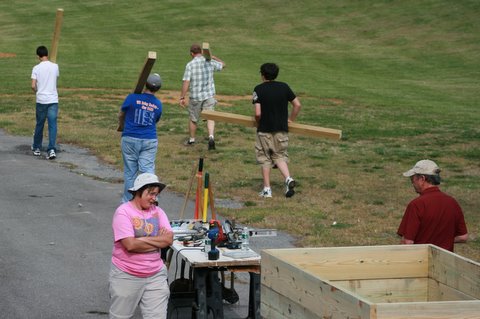
We have had several work days with assistance from the Church Hill Volunteer High School FFA Students. Steve Hutson and students are shown constructing the Boxes for the Garden 


The piled up several to help in the building of multiple boxes of the same size.  There are three different size raised beds that are needed for the garden.  The basic size is a 4'x8' box.  Three  4'x12' were built.  There were also, Four 4'x4' boxes made. 


Marcia Vandermause is on of the two Master Gardeners that is assisting with our project.  She is contemplating the placement of the boxes.  We have developed a plot diagram that shows the current and future implementation of the site. 


The beds were moved to the garden and positioned.  We laid the framework down to outline the shape, then dug the frame down several inches.  The soil that was removed was placed in the inside of the frame.  This gives some soil depth inside the raised bed.  This is an interim step in the soil building process.  Compost will be made at  the site and will be used to augment and improve the original soil form the former pasture. 


The posts for the compost bin were transported to the holes.  The City of Church Hill thankfully dig the post holes, saving us a big effort to do this by hand.  A bit later, the posts were cemented in place and the framework of the compost bin was built.  There are three bins contemplated as the plan is fully implemented. 

Thursday, April 15, 2010

Progress

This makes it official.  

The City of Church Hill has put up a sign announcing the garden.  Since the last post. the site has been tilled and is awaiting one more massage before we start the construction of the raised beds.   Samples have been taken for the soil tests and sent for analysis.  The soil appears to be good loam.  The Mayor says it is "Good Hawkins County Soil."  Prior to purchase by the City the property was kept in pasture for many years. 


We have received welcome and wonderful support for our project from the Church Hill Community Clothes Closet.  They have made a contribution that enabled us to purchase materials for 16 raised beds in three  configurations and also a large compost bin.
The materials were ordered on April 15 from Builders Supply in Church Hill.  We are also grateful to them for the discount they provided. 

Marie Keith from the Community Clothes Closet is shown helping determine the materials for the raised beds. Other donors have contributed seeds packages, okra seed, and seed potatoes. 

We have received support from the Church Hill Volunteer High School FFA.  With their support, we will be quickly assembling the raised beds, placing them in position and filling with soil from the pathways.  In the next couple of days we hope to schedule a work day to "git r dun" 

With the materials we have purchased, we will be able to complete almost 50% of our long term goals for the site.  To our knowledge, the community garden is the First in Hawkins County.  The response of the Center members and our Community has far exceeded even the wildest expectations.  We will continue to develop our plans with enthusiasm and optimism for the future.  From dirt to dinner looks much closer today. 

Friday, March 19, 2010

Tilling the Soil and our Master Gardeners

On March 17, the City of Church Hill plowed over the CHSC garden plot.  Located on level ground adjacent to the City and police offices, the plot is 50'x50'.  The event was followed by Jeff Bobo, a journalist for the Kingsport Times News.  He is shown interviewing Mayor Dennis Deal, Brian Kramer and Judy Penley.  The newspaper story and an accompanying video appeared in the Times News on March 18th.  The video clip is at the website, timesnews.net.  Tilling will begin shortly.
We have begun to collect seeds for the garden.  A sign and collection box were placed in the senior center and a large number of packets have already been contributed. 
Master Gardeners
The Master Gardener program is an outreach effort of the USDA extension service.  The MG's are volunteer participants that have undergone training and contribute their time in many community projects.  Our garden has received preliminary approval for a Master Gardener Project.  Projects are evaluated using a checklist that looks at community need, sustainability, funding, project costs and duration.  With the approval, a Master Gardener is assigned.


MarciaVandermause is our primary Master Gardener.  She is from Rogersville and has been in the East Tennessee area for about 5 years.  We completed the Project paperwork when she visited the Center and she gave it preliminary approval.  She also had several suggestions about obtaining some PeoplePower for some of the more physically demanding gardening projects. 

We are going to contact Volunteer High School for assistance from the FFA and other students to help grow some plants for the garden, assist in the construction and positioning of the raised beds, and help with some of the other physical chores.

Since the newspaper article there have been several people that have contacted us about how they could participate.  A new transplant from California has no garden space here and wants to work in the gardens.  A neighbor contacted us to volunteer with rototilling between the rows.